
As robot mowers have become more advanced, the technology behind them has evolved rapidly. One of the biggest developments in recent years has been the introduction of RTK navigation, allowing many robotic mowers to operate without the need for traditional boundary wires. While the term “RTK” is becoming increasingly common in product descriptions, many homeowners are still unsure what it actually means or whether an RTK reference station is something they need to consider before buying a robot mower.
RTK stands for Real-Time Kinematic positioning. In simple terms, it is a highly accurate form of satellite navigation that allows a robot mower to determine its location with remarkable precision. Standard GPS is suitable for many everyday tasks, such as finding directions while driving, but its level of accuracy can vary by several metres. For a robot mower expected to follow precise mowing patterns and avoid leaving strips of uncut grass, that level of variation is simply too great.
RTK technology improves this accuracy by using correction data that refines the mower’s satellite position. This allows many modern robot mowers to know their location within just a few centimetres, enabling them to mow in organised, efficient patterns rather than relying on random movement around the garden.
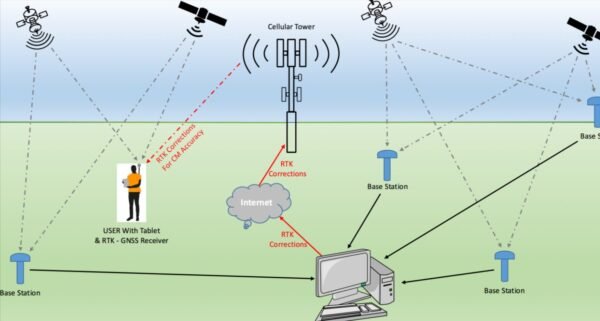
This is where the RTK reference station often comes into the picture. A reference station is installed at a fixed location within or near the property. Because its position never changes, it continuously compares its known location with the satellite signals it receives. Any small positioning errors are identified and correction information is transmitted to the robot mower, allowing it to maintain highly accurate navigation while it works.
For many homeowners, this extra level of precision offers significant advantages. Instead of wandering around the lawn in unpredictable patterns, the mower can follow carefully planned routes, reducing overlap and ensuring more consistent coverage. This often leads to shorter mowing times, greater battery efficiency and a more uniform appearance across the lawn.
However, not every RTK mower relies entirely on a physical reference station. Some manufacturers now use cloud-based correction services or combine satellite positioning with mobile network connectivity to deliver similar levels of accuracy. In these systems, correction data is received through the internet rather than from a dedicated base station installed in the garden.
Whether a reference station is necessary depends largely on the specific mower you choose. Some models require one as an essential part of the navigation system, while others have alternative methods for obtaining correction data. Understanding how each manufacturer’s system operates is therefore an important part of comparing different robot mowers.
Retailers such as Garden Machinery Direct often help customers understand these differences because the most suitable navigation system depends not only on the mower itself but also on the characteristics of the garden where it will be used.
Garden layout plays an important role when deciding whether RTK technology is appropriate. Large open lawns with a clear view of the sky are often ideal environments for satellite-based navigation. In these conditions, the mower can receive strong satellite signals and maintain highly accurate positioning throughout its mowing schedule.
More complex gardens require additional consideration. Tall buildings, dense tree cover, high hedges or enclosed courtyards may partially block satellite signals in certain locations. While many modern RTK systems are designed to cope with temporary interruptions by combining satellite positioning with onboard sensors, gardens with significant overhead obstructions may not always achieve the same level of performance as wide open spaces.
This does not automatically mean RTK technology is unsuitable. Many advanced robot mowers use multiple navigation methods simultaneously, allowing them to continue operating effectively even when satellite reception becomes less reliable for short periods. Nevertheless, understanding the environment in which the mower will operate helps ensure realistic expectations.
One of the biggest attractions of RTK technology is the flexibility it provides. Traditional boundary wire systems require physical cables to define mowing areas and exclusion zones. If the garden layout changes, those wires often need to be repositioned. RTK systems frequently allow these boundaries to be adjusted digitally through an app, making it much easier to accommodate new flower beds, patios, vegetable plots or landscaping projects.
Installation is another area where RTK systems can offer advantages. Without the need to bury or peg boundary wires around the lawn, setup is often quicker and less disruptive. Digital mapping also makes it easier to create multiple mowing zones or temporary exclusion areas without carrying out physical alterations in the garden.
Long-term maintenance may also be simpler. Boundary wires can occasionally become damaged during gardening work, aeration or landscaping projects. Since RTK systems generally eliminate these wires altogether, there is no cable to repair if the garden is modified in the future.
Cost, however, should also be considered. Robot mowers equipped with advanced RTK navigation often carry a higher purchase price than more traditional models. For some homeowners with relatively simple gardens, a conventional boundary wire mower may continue to provide excellent performance without requiring the additional investment associated with satellite-guided navigation.
The pace of development in robotic mowing also means that RTK technology continues to improve each year. Better satellite reception, enhanced mapping software and increasingly intelligent navigation algorithms are making these systems suitable for a wider variety of gardens than ever before.
Ultimately, the question is not simply whether you need an RTK reference station, but whether the entire RTK navigation system matches your garden, expectations and future plans. For homeowners who value flexibility, precise mowing patterns and the ability to modify lawn layouts digitally, RTK technology offers compelling advantages. By understanding how reference stations work and comparing the different navigation methods available, you can choose a robot mower that provides reliable, accurate lawn care both now and as your garden continues to evolve.