
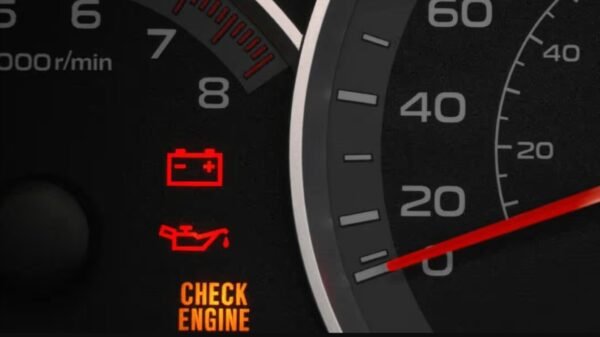
Your car has an onboard diagnostic system, also referred to as OBD-II. It is linked to the check engine light. This system monitors the:
- Engine performance
- Fuel consumption
- Emissions system
- Sensor data.
When the system notices an abnormal reading, it records a diagnostic trouble code. Then it activates the engine warning light.
The light may be in either of two forms:
- Solid light: It shows a non-urgent problem that needs to be diagnosed in the near future.
- Flashing light: Indicates a serious issue that can harm the engine or emissions system if not addressed.
The warning light does not specify the exact problem. But a diagnostic scan tool can access the stored codes and assist technicians in finding out the cause.
In this post, we will tell you about possible causes of the engine warning light. This understanding will help you to act accordingly and avoid significant mechanical issues.
Loose or faulty gas cap
In modern vehicles, the fuel system is closed. This prevents the fuel gases from escaping into the atmosphere.
In case the gas cap is not tightened properly, the system detects a pressure leak. This problem can cause the warning light to come on. The emissions monitoring system detects a disruption in the fuel vapor containment system.
The solution can be:
- Tightening the gas cap.
- Replacing it.
But when the light remains on, a professional Auto Repair Virginia Beach VA is necessary. Mechanics usually scan the vehicle computer to determine the source of the leak.
Faulty oxygen sensor
This part measures the level of oxygen in exhaust gases exiting the engine. This data helps the engine control module to vary the air-fuel ratio. This is necessary to achieve the best combustion.
The sensor could fail and cause the engine to operate inefficiently.
Typical symptoms are:
- Decreased fuel economy
- Rough engine operation
- Increased emissions
- Continuous check engine light.
A faulty oxygen sensor is a fairly easy repair. However, not replacing it on time can lower fuel efficiency. It can even ruin the catalytic converter.
Malfunctioning spark plugs or ignition coils
Spark plugs ignite the air-fuel combination in the engine cylinders. The ignition coils provide the high voltage required by spark plugs.
When these parts wear out, the engine can have misfires.
Symptoms of ignition system issues include:
- Engine hesitation during acceleration
- Rough idling
- Reduced fuel efficiency
- Difficulty starting the engine.
Misfires can activate the check engine light. This is because incomplete combustion influences the performance of the engine and the level of emissions.
Always replace the worn-out spark plugs at the prescribed intervals.
Malfunctioning mass airflow sensor
This sensor determines the amount of air that is flowing into the engine. This data helps the car’s computer estimate the right amount of fuel to burn efficiently.
The sensor can malfunction or get contaminated. As a result, the engine control system can deliver incorrect fuel quantities.
This can result in:
- Engine stalling
- Poor acceleration
- Reduced fuel economy
- Activation of the check engine light.
The issue is normally solved by:
- Cleaning the sensor
- Changing it.
Routine replacement of air filters can also prevent contamination affecting the mass airflow sensor.
Catalytic converter issues
The catalytic converter minimizes harmful emissions made during combustion. This includes:
- Carbon monoxide
- Nitrogen oxides
- Hydrocarbons.
It transforms them to less dangerous gases before they leave the exhaust system.
When the converter is clogged or damaged, the vehicle may have:
- Reduced engine performance.
- Poor fuel economy.
- Higher exhaust emissions.
- Overheating in the exhaust system.
The failure of a catalytic converter may also be caused by another component failure, including:
- An oxygen sensor
- A spark plug.
A catalytic converter is costly. Therefore, a professional check at the London Bridge Auto and Transmission Repair Shop Virginia Beach goes a long way. It will save you from costly repairs.
Emissions system leaks
Modern cars have sophisticated emissions control mechanisms. They are meant to minimize environmental pollution. These systems include:
- Hoses
- Valves
- Sensors
- Fuel vapor parts.
The leakage in the emissions system can be caused by:
- Cracked vacuum hoses
- Faulty purge valves
- Damaged vapor canisters.
In case of leakage, the onboard diagnostic system shows unusual pressure. This triggers the warning light.
These issues might not impact the vehicle’s performance directly. But they can lead to emissions test failure. Thus, they should be resolved without delay.
The key takeaway
When you notice the check engine light, seek a professional diagnosis immediately. Avoid making a guess about the cause. This may result in unnecessary repairs. And any small malfunction can quickly evolve into expensive maintenance.
A diagnostic scan recalls the precise trouble code that the car’s computer has saved. These codes give information regarding:
- The affected system
- Sensor readings
- Conditions under which the fault was experienced.
Technicians decipher this data to know the cause of the problem. In certain situations, further testing may be necessary before proceeding with parts replacement.
Such a methodological process makes sure that the repairs are made on the right part.