
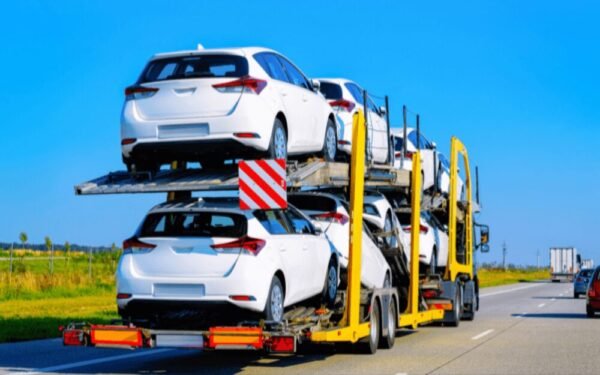
The decision to ship a vehicle versus drive it is usually framed around cost, time, and convenience. Rarely does the environmental dimension enter the conversation — yet on long Canadian routes, it is one of the more compelling arguments for professional transport, and one that is increasingly relevant to owners who are making consumption decisions with emissions in mind.
The logic is straightforward but counterintuitive on first encounter. A large carrier truck burning diesel across the country seems like the obviously heavier footprint. The reality, when the math is done properly, is more nuanced — and on long routes, often reverses the intuition entirely.
How the Emissions Comparison Actually Works
The emissions comparison between driving and shipping a vehicle comes down to one key concept: load sharing. A single car driven across Canada produces emissions attributed entirely to that one vehicle and its occupants. The same car on a carrier truck shares the truck’s emissions across every vehicle on the load — typically six to nine vehicles on an open carrier.
A modern carrier truck moving nine vehicles from Calgary to Toronto burns significantly more fuel than a single car making the same journey. But when the truck’s total fuel consumption is divided across nine vehicles, the per-vehicle emissions figure drops to a fraction of what a solo drive produces. On a Vancouver to Montreal run, a typical passenger car driven solo produces roughly 450 to 600 kilograms of CO2 depending on fuel efficiency. The same vehicle’s share of a carrier truck’s emissions on the same route, divided across a full load, is typically 60 to 120 kilograms — a reduction of 70 to 85 percent.
The principle is the same one that makes buses and trains lower per-passenger emitters than private cars: collective movement is more efficient than individual movement at scale. A carrier truck is, in environmental terms, a vehicle that moves nine cars with the emissions of roughly one and a half.
The Route Length Variable
The emissions benefit of shipping grows with route length. On a short move — say, Toronto to Ottawa — the difference between driving and shipping is smaller in absolute terms because both options involve a relatively modest fuel burn. On a transcontinental move from Vancouver to Halifax, the emissions differential becomes substantial.
This is one reason why the environmental argument for shipping is most compelling precisely where the logistical argument is also strongest: on long-haul moves where the drive itself would take multiple days, burn several tanks of fuel, and put thousands of kilometres on the odometer. The two arguments reinforce each other at the distances where they matter most.
For moves within southern Ontario or between closely spaced cities, the emissions case for shipping is weaker — not because carrier transport is less efficient per vehicle, but because the absolute emissions involved are smaller on both sides of the comparison. The calculus changes at the distances that define most interprovincial Canadian moves. Car shipping in British Columbia on long eastbound corridors represents exactly the route category where the environmental benefit of carrier transport over solo driving is most pronounced.
Electric Vehicles and the Charging Infrastructure Argument
EV owners considering a long cross-country drive face a dimension that conventional vehicle owners do not: the availability, speed, and reliability of fast-charging infrastructure across the full route. Canada’s charging network has expanded significantly in recent years but remains uneven — major corridors between large cities are increasingly well-served, while rural segments and less-travelled provincial highways have gaps that require careful route planning and range management.
A long EV drive is not simply a matter of plugging in at convenient intervals. It requires planning charging stops around station availability, managing range anxiety on segments where the next charger is far enough away to require conservative driving, and accepting that the driving pace is partly dictated by charging needs rather than purely by driver preference.
Shipping an EV eliminates the charging infrastructure challenge entirely. The vehicle arrives at the destination with whatever charge the owner specified at handover, and the first charge happens at the destination’s own infrastructure rather than along an unfamiliar route. For EV owners making long interprovincial moves who are already committed to minimizing their environmental footprint, shipping also preserves the vehicle’s battery health by avoiding the deep cycling and thermal stress that a long highway drive at sustained highway speeds can accelerate. Car shipping in Ontario for EV owners moving to or from the province combines the emissions efficiency of carrier transport with the practical benefit of avoiding long charging stops on a route where time and logistics are already demanding enough.
The Indirect Emissions of the Drive
The direct fuel burn of driving is not the only emissions dimension of a cross-country drive. Accommodation stays along the route, food purchased at highway stops, and the energy consumption of the facilities and services used during a multi-day road trip all carry embedded emissions that rarely appear in the comparison.
These indirect emissions are individually small but collectively meaningful on a five-day transcontinental drive. Hotel stays, restaurant meals, and the operational footprint of highway service stations add a layer of consumption that a shipped vehicle’s journey does not generate for the owner — the carrier’s operational footprint is already absorbed into the load-sharing calculation.
This is not an argument for obsessive emissions accounting on every travel decision. It is a reminder that the environmental comparison between driving and shipping is genuinely more favourable to shipping than the simple fuel-burn calculation suggests, particularly on the long routes where the indirect consumption adds up across multiple days of travel infrastructure.
Enclosed Transport and the Emissions Trade-Off
Enclosed transport carries a higher per-vehicle emissions share than open carrier transport, for straightforward reasons. Enclosed trailers carry fewer vehicles per load — typically two to six compared to six to nine on open carriers — and the heavier trailer itself requires more fuel to move. The per-vehicle share of the carrier’s total emissions is therefore higher on an enclosed shipment than on an open one.
For most vehicle types, this trade-off does not change the fundamental comparison with solo driving. Even on an enclosed carrier moving only two vehicles, the per-vehicle emissions share of the truck’s journey is substantially lower than a solo drive on the same route. The enclosed option narrows the environmental margin compared to open transport, but does not reverse it on any route of meaningful length.
The exception worth noting is for short-route enclosed shipments where the carrier load is very small. A single vehicle on a dedicated enclosed transport over a short distance produces an emissions profile closer to a solo drive than the long-haul multi-vehicle scenario. For owners who are weighing enclosed versus open transport on environmental grounds, the load factor — how many vehicles the carrier is moving on the same truck — is the variable that matters most.
Making the Decision with Environmental Factors Included
The environmental case for shipping does not need to be the primary reason for the decision. Cost, time, physical convenience, and vehicle wear are all legitimate and often decisive factors. But for owners who are making the comparison with their full impact in mind, knowing that shipping on long Canadian routes is also the lower-emissions option removes any residual sense that choosing professional transport is somehow the less responsible choice.
It is not. On routes above a thousand kilometres — which covers most significant interprovincial Canadian moves — carrier transport is the more efficient option by a meaningful margin, for both the owner’s wallet and the atmosphere. The two outcomes happen to point in the same direction, which is a more common alignment than is usually recognized in the transport decision conversation. Auto transport on Canada’s long corridors is not a convenience that trades off against environmental responsibility. It is, on the math, the option that does less damage while also being easier.
Frequently Asked QuestionsHow much lower are emissions when shipping a car versus driving it from Vancouver to Toronto?
The per-vehicle emissions of carrier transport on a Vancouver-Toronto run are typically 70 to 85 percent lower than a solo drive in a conventional passenger car, based on the load-sharing effect across a full carrier load. The exact figure depends on the carrier’s load factor, the truck’s fuel efficiency, and the car being driven. The directional conclusion — shipping is significantly lower — is consistent across reasonable input assumptions.
Does it matter which type of carrier is used from an emissions standpoint?
Yes. Open carriers moving six to nine vehicles distribute the truck’s emissions across a larger number of vehicles, producing a lower per-vehicle share than enclosed carriers moving two to six. For owners for whom the emissions comparison is a meaningful factor, open carrier transport produces a more favourable environmental outcome than enclosed on the same route, all else being equal.
Is the emissions benefit of shipping significant enough to factor into the decision?
On long routes, yes — the reduction is large enough to be meaningful rather than marginal. On short routes, the absolute emissions involved are smaller on both sides and the proportional benefit, while still present, is less decisive. The environmental argument for shipping strengthens with route length, which happens to mirror the logistical and financial arguments that typically drive the decision on long Canadian moves.